
Thought Forms
Eternal Imprints

What if your thoughts never die?
What do you think about when you think about your thoughts?
Some thoughts are fleeting. Some linger for years. Some appear and vanish like sparks in the dark, while others become recurring visitors that shape our moods, our beliefs, and ultimately our lives. There are positive thought patterns and negative thought patterns, constructive thoughts and destructive ones. It is fascinating how some dissipate while others seem determined to stay.
But what if none of them ever truly disappeared?
What if every thought you’ve ever had continues to exist in some form beyond the reach of your five senses? What if thoughts are not as temporary as they seem? What if, once thought, they become permanent additions to the fabric of existence?
This is a belief I have recently begun to explore—the idea of thought forms.
The notion that what is produced in the factory of my mind is not impermanent. It may become invisible to me, but it does not cease to exist. Every thought that has passed through this brain may continue onward in some shape, form, or energetic imprint, forever.
In 2026, I found myself going down a rabbit hole of Near-Death Experience (NDE) and Out-of-Body Experience (OBE) testimonies. While they are different experiences, they often share strikingly similar themes. One of the most common ideas I encountered was this: our thoughts never truly leave us. They remain part of our essence. They become woven into the story of who we are.
Many of these accounts describe what is often called a “life review”—a panoramic replay of one’s life in which every action, every interaction, and even the thoughts accompanying those moments are revealed and experienced with complete clarity. The overwhelming message wasn’t one of punishment or judgment. Instead, it was one of understanding.
One experiencer described the pain of stepping outside of love and embracing hatred. Not because someone condemned him for it, but because he felt the contrast so completely. He said it was the greatest pain he had ever known. When he returned, he was transformed.
If there is even a possibility that this is true, it changes the way I think about thinking.
Because if thoughts endure, then so do the darker ones.
And I’ve had my share.
Thoughts born from fear. Thoughts fueled by resentment. Thoughts rooted in despair. Horrific imaginings that harmed no one but myself, yet still left their mark. If these testimonies are correct, those thoughts become part of my story. Not something I am condemned for, but something I may one day have to fully understand.
That realization could be unsettling.
Instead, I find it motivating.
I don’t want to wait for a Near-Death Experience or an Out-of-Body Experience to learn this lesson. I want to apply it now.
I am far from perfect, but I have become increasingly aware of my mental landscape. When my mind drifts toward darker territory, I can often detect it, detach from it, and redirect it. Not only because I believe thoughts may last forever, but because thoughts have consequences right now.
Thoughts become things.
Everything human beings have ever created began as a thought.
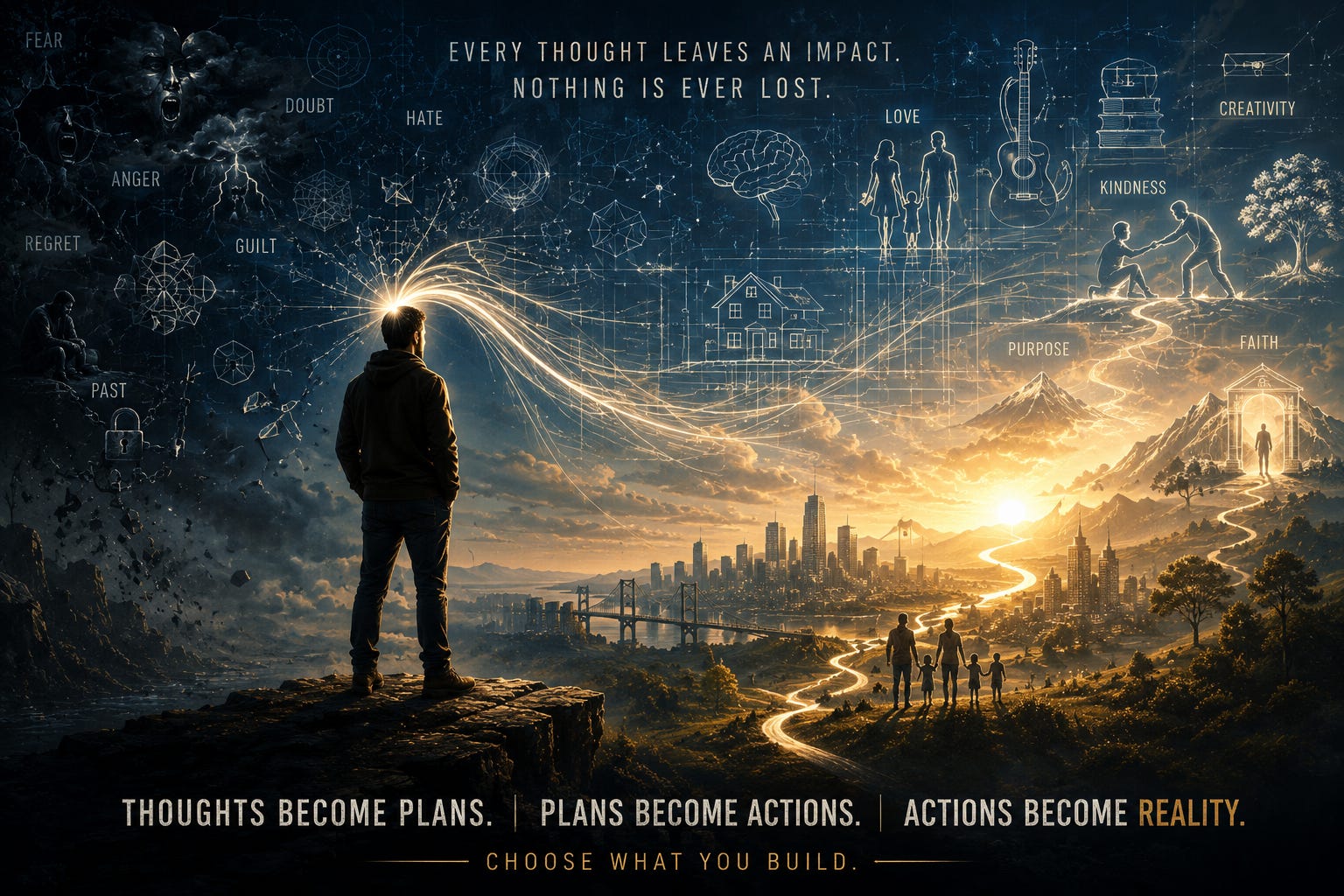
A building begins as an idea in the mind of an architect. Before there is concrete, steel, or glass, there is imagination. The architect’s thoughts become blueprints. The blueprints become action. The action becomes a building.
Thoughts are manifestation machines—not in some mystical sense, but in the most practical sense imaginable.
Thoughts become plans.
Plans become actions.
Actions become reality.
Thoughts are blueprints, so choose them carefully.
What are you building?
If I could offer one recommendation, it would be to focus on what brings you joy, meaning, growth, and connection. Direct your attention toward what you want to cultivate rather than what you fear. Where attention goes, energy follows. Over time, what you repeatedly think about begins to take shape in your life.
Likewise, be cautious of poisonous thoughts. Not because they make you a bad person, but because they have a way of shaping your experience from the inside out. Thoughts are chemists. Thoughts are effective alchemists. They can transform a difficult circumstance into a lesson, a setback into an opportunity, or suffering into wisdom.
A thought can find the blessing hidden inside the struggle.
A thought can turn an ordinary day into a meaningful one.
A thought can change everything.
This is why so many traditions place such importance on mastering the mind. Mindfulness. Meditation. Prayer. Stoicism. They all point toward the same fundamental truth: your thoughts matter.
The Stoics understood it.
The Buddhists understood it.
Jesus understood it. (Matthew 15:18-19)
Modern neuroscience increasingly supports it.
And in my own life, I have experienced it through Transcendental Meditation.
Twenty minutes, twice a day. Just me and a mantra.
I use other practices as well—different ways of exploring the subconscious, bringing pieces of it back into conscious awareness, and learning to better manage what is happening upstairs.
Because whether thoughts last forever or not, they are unquestionably powerful.
And if there is even a chance that every thought leaves an imprint, then perhaps one of the most important things we can do is learn to think with intention. Especially if we are building something with every thought we choose to entertain.
Jesse, "Eternal Imprints" strikes home. The longer we live, the more we're snowed by all the impressions garnered from our senses. Some of us are wired to strongly internalize every single impression; trying to control thoughts and eradicate or placate the worst ones is my ultimate goal. As you mention, Buddhism suggests mindfulness and selflessness, which I struggle to achieve. And I think you do too.
Intention is transformative. Thanks Jesse!